‘Exploding Head,’ by Cynthia Marie Hoffman

These poems have a feel for me, a texture. Take the opening lines of “MRA Machine”:

Strapped inside this bright rocket, you are a spirit ready to be launched toward the light.

Do you feel that? In the pacing, in the sound? There’s fear, but there’s also something soothing about the language because of its music.

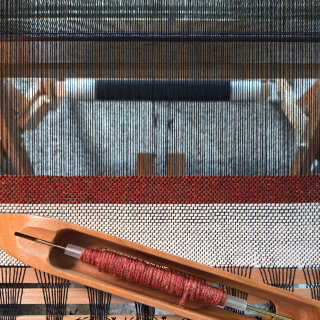
Hoffman’s prose poems feel like the warp of the subject matter coming together with the weft of the language she uses—language that, in her words, both opens up and clamps down hard. Reading the work is, for me, like running my hand across the face of newly woven fabric, nubbins and knots and all. I’m talking about poems that drape, that shoosh or scritch, that become something sensual, that conceal and reveal. I’m talking about a poet who can make a poem into a garment woven from different types of yarn that readers can step into and then back out again, both ourselves and not ourselves—the you in the poem an internal conversation in second person but also us if we allow ourselves that moment of extension into and beyond, which I willingly and gladly do. What is poetry if not a way to experience the world through a consciousness and creative expression that is not our own?

These poems sley the reed, thread the heddles, and follow the fell line as they take shape on the page as blocks of memory, experience, imagination, and disquiet.

Images: 1. The front cover of Exploding Head, by Cynthia Marie Hoffman. 2. Two interior pages from the collection. 3. Another image of the front cover of the collection, along with a dried pomegranate, a horse sculpture, and an hourglass.

Naming Names

I’ve been thinking a great deal about a comment left on Facebook in response to my last post that merits deep consideration and a detailed response. This is my first attempt at such a response. The comment was about one of the essays I shared in which several poets and writers respond to an essay about assault and harassment in the literary world. It’s about naming names, specifically this comment by Roxane Gay:

I’d name names, but these aren’t my stories. It’s not my place. That’s what I tell myself while also knowing that when we keep these men’s secrets, we allow their predatory behavior to thrive. They won’t stop until they are held accountable.

I think it’s important to note that abuses of institutional power are ultimately an institutional issue. Institutions bear responsibility for doing more than negating complaints and concerns when they’re raised or making decisions that inadequately address these situations—and often behind closed doors.

I’ve never written about this before, but many years ago, I approached the institution the poet who sexually assaulted me worked for. I was told that because I wasn’t one of his students and because the assault didn’t happen on his campus, I couldn’t even make a complaint. But it did happen en route to a college campus, one where he was representing his school and one where he’d written a letter of recommendation for me for the MFA program he was dropping me off at. And I may not have been his student, but he was working with me as a mentor. He also, I realized in retrospect, engaged in grooming behavior several months earlier at the first and last AWP I ever attended.

Most of these abuses in the literary community occur in conjunction with a school, a school-supported event, a literary organization, or some other entity in which the poets in question are serving in formal and informal roles. Those institutions need to do better. Universities and colleges need to do better. Associations need to do better. Conferences need to do better. Publishers need to do better. Journals need to do better. And so forth.

Until complaints are taken seriously and appropriate action is taken, nothing will change and those who have these experiences will continue to feel invalidation, fear, shame, and guilt on top of the trauma from the experience itself. Some may stop writing entirely, as I did for seven years. Some may experience such fundamental shifts in their bodies and minds that they never feel like themselves again, not even years later.

Gay says she doesn’t name names because the stories aren’t hers to tell. I understand that and believe every survivor of these kinds of experiences has the right to discuss, or not discuss, what happened to them in whatever detail and whatever way makes sense for them. If we all rely on those affected to be the only ones naming names, though, we’re shifting responsibility not only for what happened—and the trauma of what happened—to those who often have little to no power and are often survivors of other abuses, but also for the naming and the responsibility and added vulnerability (and possibly targeting) that comes with that.

Speaking at all is terrifying. Carrying the twin burdens of having been abused and also having to publicly name the person who abused is heaping a whole lot on survivors of a system they didn’t create, one that has harmed them and that will most likely not change in any significant way—no matter what they say (other than to expunge those who speak).

And the fact is, many of us have named names. We’ve told the institutions that abusers are affiliated with exactly what happened. And they’ve looked the other way, protected their own, and allowed such abuses to continue.

Experts in the Field

It’s not that bad, they say. It happened a long time ago, they say. He was drunk, they say. One of these men is the publisher of a well-regarded imprint. Another is a poet. Another is a magazine editor. Another is a small press writer. And another. And another. It’s time to start naming these men. I’d name names, but these aren’t my stories. It’s not my place. That’s what I tell myself while also knowing that when we keep these men’s secrets, we allow their predatory behavior to thrive. They won’t stop until they are held accountable. — Roxane Gay

This is just one response that’s part of “Roxane Gay, Aimee Bender, and More on Assault and Harassment in the Literary World,” a collective essay published by Literary Hub in response to Bonnie Nadzam’s essay “Experts in the Field,” which ran in Tin House on February 6, 2017. Other responses are from Ramona Ausubel, Sally Ball, Aimee Bender, Kristi Coulter, Porochista Khakpour, Erin Coughlin Hollowell, Anna March, Aspen Matis, Elissa Schapell, and Sarah Vap.

I don’t know how I just came across both of these essays today, more than a decade after they were written. It’s probably because I left poetry two years before each piece was published as a result of my own experiences with being harassed, assaulted, and otherwise harmed from 1995, when I first started writing poetry, forward. My departure in 2015 was meant to be permanent. I had no intention of writing again. That changed seven years later, in 2022, after a cascade of serious health issues left me close to death. Suddenly, poetry was the only thing that could help me make sense of my past, my present, and whatever my future held. I vowed never to leave it again.

I’m at a different but not-so-different juncture now, after dealing with the poetry community again over the past four years. What I’m experiencing and witnessing isn’t as bad as the assault that caused me to leave poetry in 2015, but I realize the potential for assault is still there, even if I know how to identify grooming tactics and other red flags earlier. That doesn’t mean the space is safer, only that I know how to stay safer in the space. Many of the infractions I’ve detailed recently have occurred since I returned to poetry.

What I’m having a hard time with is the fact that Nadzam’s essay and the responses to it could have been written today, not more than a decade ago. Expand them so they don’t conform to the gender binary but instead focus on abuses of institutional power committed against those who have less or no power, and you would be describing the poetry community as it is structured now, from those who engage in abuses to those who are somehow complicit in those abuses to those who are abused and don’t even have the closure of giving voice to what happened to them. (I’m not saying these expanded definitions are new. I’m saying the male-female framework in the original essays carries certain biases and isn’t inclusive of everyone who’s abused. In my case, for example, I’m nonbinary, so not female and not a woman. Still, the way I am seen has made me vulnerable, perhaps more so because I don’t fit the gender-binary framework.)

I’ve been surprised recently when male poets have reached out to me to express their shock over some of the experiences I’ve shared. I say male because men are the only ones who reach out to me in this way, with both an absence of similar experiences and without any knowledge that such issues exist. One praised me for not writing about a recent incident and seemed to think my writing about it would be an attempt to embarrass the poet involved rather than to tell the truth about what happened and hold someone accountable who may have been engaging in this same behavior with other poets for years, or even decades, with impunity.

Given all the ways in which poets have made abuses in poetry known for many years now, it’s hard to believe there are poets out there who have no idea any of this is going on, who haven’t even heard whispers about this or that over the years. And given the call from poets like Roxane Gay to hold poets and writers accountable for their actions, I have a hard time with anyone suggesting I remain silent on any matter, especially one like this, that already cost me a good chunk of my life and has forever changed me as a person.

My Dead

People love the rubber until the rubber meets the road.

I’m buying jade cicadas for all my dead is how I am.

My dead, carry me home. My dead, carry me home. Through fire, make me warm. Under water, make me fluid. Across earth, make me solid. From air, breathe your dead breath into me. Carry me home, my dead. Carry me home, my dead. I will carry you, too.

A physician who arrived on the scene after ICE agents shot Alex Pretti said the officers were not performing CPR. Instead, they appeared to be counting Pretti’s bullet wounds. (Sources: MedPage Today, Daily Kos)

I’m carrying my dead.

Birds need water as much as they need seed. Love needs action as much as it needs language.

The first murder was nearly half a million years ago, which shows violence has been in our nature since our ancestral humans. The blows were directed at the face so the killer could see who they were killing as they were doing the killing. Does it surprise me that the agent who fired the last five shots did so while Pretti was lying unresponsive and face up? Not at all. He wanted to see who he was killing as he was killing him, to see who he was destroying as he destroyed him. This is an old story. Hate is as old as love. But compassion had already evolved in our ancestors as sustained and long-term, as a way of showing commitment to others and surviving as a group. I believe our capacities for love and compassion are greater than our capacity for hate. I believe they can help us survive, even when that means surviving each other.

I’m so sad that I know this sadness cannot be entirely my own.

Wael Tarabishi

A man in the Oklahoma birding group just called a northern mockingbird his northern mockingfriend.

Holding in pee when I’m ten steps from the bathroom is how I am.

I think Utahns should bring back the whistling and whittling brigade, but only to get ICE out of the state.

I think I like poets about as much as I like librarians. I say that as a poet who almost studied library science and who’s been around a bunch of poets and worked in libraries alongside a bunch of librarians. I like what poets and librarians do. I like what they stand for. I just don’t expect much from either group when it counts. Look, words. Look, data. You know?

Weavers and birders on the other hand? Fuck yeah. All the fuck yeahs. Take umbrage with this post if you must. Take my disappointment, frustration, and annoyance, too, while you’re at it.

Of course I don’t mean any of this. I mean the weavers and birders part. They’re the folks I turn to when even caramel corn isn’t enough to see me through.

Who’s keeping me alive right now? Oklahoma birders, that’s who. They don’t just post photos of birds. They tell stories, like this one:

This roadrunner got under the hood of my Cutlass and rode all the way from Don and Loel’s house in Tuttle to my home in Moore, Oklahoma, and lived in our neighborhood for almost a year before disappearing.

That is the shit, my friends. A gem of a story in only thirty-eight words.

These typos in a post by Blue Ridge Wildlife Center are perfect: If you believe that loons can take off from land, is lie. Liar told you that. From now on forever, I am going to say Is lie. Liar told you that whenever the situation warrants it.

You know how you get a weird answer from a Magic 8 Ball, so you just jiggle it? I sometimes find myself wanting to jiggle people a little into a different mindset or behavior. Not violently. Just so their hollow icosahedron floating in its cobalt alcohol solution will land on a better face.

I’m eating a whole thing of caramel popcorn with my tongue so I can keep typing is how I am.

Carolyn Kizer didn’t shut up, either.

I know folks don’t mean to. That’s part of the problem.

Thank you for coming to my fuck you.

I dreamed I was at a rave but didn’t want to be, so I went outside and picked up dog poop from people’s lawns.

Hugging my weighted therapy dragon is how I am.

They all killed him. Every agent who harassed him, restrained him, kicked him. Maybe one of them shot. Maybe more than one. But they all killed him. They are all the shooter.

GestapICE.

Alex Jeffrey Pretti

Hundreds of words that translate to one: dismissal.

From a member of the Oklahoma Ornithological Society: Folks, we have a native songbird killing event starting tomorrow for many of the states in the United States. This is supposed to go for over a week in my area (Oklahoma). If you have nesting boxes up for bluebirds and other cavity nesters, consider adding a handful of clean, dry pine needles or straw for insulation. Make a bowl with your fist pushing the needles or straw up the sides. Also, do whatever you can to feed these native songbirds and offer fresh water. I use an old frypan with a small heater in it on my back deck rail and change it twice per day. I also have a larger birdbath in the yard that also has a heater in it. Good luck to everyone. Stay safe.

I keep misreading bandanas as bananas and wondering why I need to stock up on bananas to stay warm in style all winter long.

I dreamed I doubled as a fire extinguisher.

I mentioned assless chaps one time in a comment on a friend’s post, and now Facebook is showing me all these ads for assless chaps is how I am.

For me, the pronoun they works on many levels. One complaint about using they in the singular is that it’s grammatically incorrect. But is it? The mind is plural and decentralized. We may be one, but “I” may not even be a thing other than an understanding between us, a kind of “you there, me here” shorthand, a fiction that appears to simplify living. They is a better pronoun for me than he or she any day. It does more than help me escape the waist trainer of gender essentialism. It helps me remember that my mind is not one and never was and never will be.

When we lived in Seattle, everyone thought my life partner was Moby, especially at the health-food store. I was like THAT’S MY MOBY GET YOUR HANDS OFF MY MOBY.

Nobody owns language or its rhythms. It’s what we make it, all of us, not what power wants to make it.

I’m not ashamed to say I’ve prayed to God for my daily zero-sugar Cherry Coca-Cola.

I’m dipping turkey bacon in chocolate hummus is how I am.

Please can I just be plastinated now please please pretty please.

Can you guess what I’m doing based on what I’m wearing: a tank top, a tennis skirt, kneepads, a headlamp, slippery socks, my reading glasses, earplugs.

The other day, the life partner and I were watching television before bed when the remote control slid off the sofa and landed with a thud on the area rug. We were both silent as we tried to figure out what happened. Then the life partner said, in all seriousness, Detachable penis.

We heal together. We heal in community.

The purple gallinule found in Massachusetts who wasn’t named at the wildlife rescue where she was taken so the staff wouldn’t get attached to her? Her name is Tandy. I’m naming her Tandy.

I just misread a headline as Reducing Puppet Size May Help with Night Driving. I was like of course the puppets should be smaller so they don’t block the view, especially when it’s dark out. Pupil. The actual word was pupil.

Bewildering Cage is, as of this very moment, the title of the manuscript I’m working on. It fits with the body theme, the asylum/psychiatric hospital theme, with the gender identity/sexuality theme, and nature of existence theme. Thanks to Centa Therese for commenting on the Terrance Hayes poem that contains the phrase “bewildering a cage,” which I misread as “a bewildering cage,” so thanks, also, to my dyslexia. Massive thanks to Ren Wilding for reminding me we are galaxies. The galaxy itself may be a bewildering cage, but we can move around, and dance, in it. We just can. And we can talk like dolphins.

(Now I have the song “Here Comes the Rain Again” in my head, but with the lyrics changed to Talk to me / Like dolphins do / Walk with me / Like dolphins do. EEEEEEEEEEEE EEEE EEEEEEE.)

The Wasting (2016- )

Just trying to name this period in U.S. history. I think this works because it captures the wasting away of culture and the literal wasting of people in the streets.

From a Facebook ad for a dog carrier: Safety buckle prevents jump-out panic. We all need that buckle, Facebook. Every one of us has jump-out panic right now.

I am ill-equipped to hear this much talk about golf this early in the morning or ever really which is why I try not to leave the house if I can help it is how I am.

I’m doing the Safety Dance today. Ivan Doroschuk of Men in Hats wrote the song after being kicked out of a club for pogo dancing. It’s a protest against bouncers prohibiting the dance style. Often interpreted as anti-nuclear, Doroschuk says the song is more broadly anti-establishment.

I just gave myself an asthma attack by laughing too hard after doing an impression of a dolphin singing “My Sharona” is how I am.

People who are making comments like, Bring back the chokehold, can fuck all the way off.

Each success, no matter how small, in practice of what I love is a lightning strike against the dark. — Clare L. Martin

Each action, no matter how small, in service to the world is a lightning strike against tyranny. — Dana Henry Martin

Each action, no matter how small, in service to the world is a silver sound in the dark. — Ren Wilding

I organized my closet for five hours yesterday is how I am.

A birder in Oklahoma called scaled quail cottontops, and it’s the first time I’ve smiled in days.

A woman killed her six-year-old son and herself here in Utah yesterday in Canyonlands. No more. No more death. No more murder. No more horror. No more. No more. No more. No more. No more.

Her dog was in the back seat.

Today is one of those days in the desert when the wind sounds like a warning.

Poets are alive in their lines.

It’s hard in this desert rain to not feel the heavens have been slain.

We need to be together now, as poets, as creatives, as thinkers, as human beings. Whoever you turned to yesterday, whoever turned to you, may you all look back and realize that you helped each other go on. There is healing in being together during difficult times, unthinkable times. I was with two poets yesterday who made today possible by making yesterday less impossible. May Renée Nicole Good rest in peace. May we live in peace.

Listening to songs I first heard when everyone I knew and loved was still alive.

I dreamed poetry was outlawed in the United States.

There was a mass shooting in Salt Lake City last night outside an LDS church at a funeral. Two dead. Three hospitalized in critical condition. Three more injured.

Renee Nicole Good

Sometimes just by giving it language, you discover something within you that’s been waiting to be heard for a long time.

To be spared is to be pared, part of you left but part removed. To be spared means to pare, to reduce what happened to its essence and to find your own essence despite what happened. Injured but not killed. Damaged but not broken. Burned but not torched. You are what is left over, what you can afford to be, what you still have to give others. In Old English, spare means not enough. Were you not enough to be worth destroying or not enough after being destroyed? In Latin, pare means prepare. Do you feel prepared now that you’ve been skinned?

My weekly stats report from Grammarly: Grammarly analyzed 801,077 words. You were more productive than 99% of Grammarly users. If only some of those words were any good.

Writing makes the unspeakable speakable, survivable. I walk this line, this lettered terrain, until I find myself, for only then can you find me. Only then can I find you. Here we are in Ma time, in what’s happened and what could happen. The pause, the upbeat, the architecture of connecting and letting go. I’m waiting, bated, inked blood in my heart and on my tongue, reduced to vowels, then to a single sound. You know the one. That first utterance, O.

I’m about to buy my dog a treat-dispensing toy piano is how I am.

Could not sleep. Watched the news. What the fuck. I mean fuck. I mean fuck. What the fuck.

Meanwhile, in Utah: An artificial intelligence that writes police reports had some explaining to do earlier this month after it claimed a Heber City officer had shape-shifted into a frog.

This body doesn’t know which gender it is, so it’s using all of them.

(Adapted from John Gallaher’s Time doesn’t know which genre this is, / so it’s using all of them. Every time I read the word genre, I think it’s gender.)

I dreamed I accidentally dated the devil and thought he’d ruined my life, but then I yelled at him in front of everyone in a Walmart parking lot. He dove inside a gold Oldsmobile Cutlass and never came out again ever. So that’s where he is if you need to make a deal with him or whatever.


ICE OKC

In Oklahoma, the federal government is attempting to convert a 415,981-square-foot warehouse thirty minutes from the home where I grew up into a 1,500-bed ICE detention center. City attorneys and city officials say they can’t stop it because these detention centers are explicitly exempted from local zoning regulations.

That’s been the case for a long time, with precedents that date back to 1941. What’s changed is the number of people being sent to these centers. That number jumped during Trump’s first term in office and is jumping again during his current term.

What’s also changed are the conditions within these centers and the number of human-rights violations and worse occurring within them, including the homicide of Geraldo Lunas Campos, who was in ICE custody in Montana. According to a witness, five guards held him down. One put an arm around his neck and squeezed until he was unconscious and died.

Detainees held a demonstration inside an ICE facility in Dilley, Texas, two days ago to bring attention to the inhumane conditions within the facility and to demand their freedom. Among those heard shouting during the demonstration? Children.

Five-year-old Liam Ramos, detained in Minnesota last week, is one of the children being detained at the Dilley facility. He’s there with his father.

Carolyn Kizer

Let’s just call her what she was: a siren, a soothsayer, a mythmaker, a chorus, a riot. I met her. She took a sliver of me. I am but a sliver of her. You will never remove that sliver.

Image: A photo of Carolyn Kizer that ran in Poetry Northwest.

Demons

Was I creating demons when I was at a poetry dinner party in Kansas City with Carolyn Kizer, and the entire group attempted to elide over her comments when she talked about another well-known poet attempting to rape her?

Was I creating demons when a member of my poetry class in Kansas City started stalking me, leaving flowers, torn-up copies of my poems, and letters about how bad and offensive my writing was on my windshield?

Was I creating demons when a poet and publisher in Kansas City screamed in front of a large group of poets, including my best friend, that I wanted to fuck him behind a dumpster?

Was I creating demons when a poet in Seattle who had agreed to work with me on my poetry googled (from his IP address) the words married and naked in combination with my name before we met? When he then canceled the appointment, told me I was childish for writing cut-up poems, and said I was wasting his time. When he also created a fake blog username and trolled me on my site (again, from his IP address) for months, trashing everything I wrote, including my poems.

Was I creating demons when two other Southern Utah poets said my work was pornographic and I should find another state that would accept it, while refusing to let me join their two state poetry society chapters and telling me they’d stopped meeting when they hadn’t?

Was I creating demons when a poet who’d been following my work for months and said he wanted to publish some of my poems left a hostile, sanist comment on one of my microessays in which I was lamenting the fact that people are jumping from a bridge down the street? When he screamed that my writing was the last thing he needed in his life, as if he hadn’t followed me and chosen to read, and laud, my work up to that point. As if he didn’t have the power to stop reading what I wrote or unfriend me or mute me or any of a suite of well-adjusted options that were available to him. That poet later disappeared during a mental-health crisis. When I was asked to help, I skip-traced him to his brother’s house, and he was eventually found safe. Because that’s who I am. Not someone who creates demons or treats people like demons. I’m a person who helps people when they need help, no matter how they’ve treated me.

Was I creating demons when a poet asked to read one of my manuscripts, then replied that he was sorry he’d even asked to read it? When he then rewrote part of it the way he’d like to see it, infantilized me and my work, assumed the speaker was me, treated the work not as work but as the opportunity to intervene in my personal life and my past, and talked about me in extremely sexist ways. When I responded and he continued the attack and infantilization, using my own work against me by calling me a little fist of a girl, a line from one of my poems. When he continued to move between unwanted intimacy, flirtation, and attacks in successive emails, even after I asked him to stop communicating with me. Or when my life partner had to intervene to make him observe my boundary.

Was I creating demons when a poet I’d known for more than twenty years threatened me here on Facebook, publicly in front of the entire poetry community, saying I was committing both a transgression and a manipulation when I told him I loved him, platonically, as a friend, something my context made clear? Was I creating a demon when he did similar things to other women and female-bodied poets.

Was I creating demons when a poet messaged me about a gay Arab who had gotten ahold of a photo of him in bed without his shirt on and how upsetting that was for him and who then sent me that photo through DM so I could see what he was so upset about? Or when that same poet viciously attacked a woman who was experiencing psychosis and got a group of poets to gang up on and attack her, which could have put her life in danger. Or when he refused to take his public post about her down so she could get some help without being pushed further into a dangerous or life-threatening situation. Or when he later told me I was borrowing the term CPTSD and wielding the label sanism, implying I don’t live with the former like he does as a war veteran and therefore have no right to identify and address the latter. By the way, I helped that woman, too. I reached out to her directly and got her a welfare check. If I’d been in the same part of the county as her, I would have been there for her in person. That’s a lot better than telling her she’s a terrible person and getting at least a dozen other poets to do the same.

Was I creating a demon when my poetry mentor breached my trust seventeen years ago with his words and his body and his insistence and his intrusion? When he made me talk about the ways in which my father abused me and became aroused when I did so. While he had me pinned down with his body. While he talked real nice, real childlike. While he continued despite no and stop and no and no and no. That was not a demon. That was a man. And a poet. A beloved one at that. I didn’t create that man any more than I create demons.

More recently, was I creating demons when a poet told me my comment about mentors not taking advantage of their students, which stems from my own experience, didn’t need to be said because it was already implied in the statement that students shouldn’t sleep with their mentors? That, in other words, we should all just be following the programming we’ve been given, which is to place responsibility on victims for not being or becoming victims. Look at my paragraph above. What part of that looks like a mentor trying to sleep with me? What part of that could I have avoided under the circumstances? Was I creating demons when that poet interrupted me in front of a group of poets to make his assertion? How about when he turned my gender into a joke and literally wanted to tell it as a joke on his joke podcast. How about when he asked how my life partner felt about my having sex with whoever I wanted and continuing to ask me that inappropriate bullshit question even as I kept repeating the word asexual, emphasizing the first syllable in the hope he’d understand not only his error but the violation intrinsic in his question. Is that evidence of my demon-making. (Note to everyone: Just because someone uses language for their gender and sexuality doesn’t make it your right to ask personal questions about either, especially not when first meeting them.)

Was I creating a demon when a friend of the poet in the paragraph above, one who’d been supportive of me, my work, and everything I’ve discussed about poets and poetry—up until it involved someone he personally knows—sent me a message in response to my asking not to be invalidated in which he says I am marshaling evidence, finding demons, distracting from real communication, seeing a glitch as a serious issue—thereby invalidating my concern about that issue—calling me a wrecking ball, making it clear none of the poets in the group, my former friends, like me, not even the one who appears to like me, saying this very personal issue around my story of sexual assault should have been mediated in the group and as a group—as if my experience and my trauma should be on trial and the most painful parts of my life should be made freely available to the group? Then, when in order to drive the point home about what a terrible person he thinks I am, he says, I think you’re a great writer. That opinion is somehow impersonal and won’t change. Or when he ends by saying he knows his own mind and I am welcome in it anytime I welcome that.

And that was from a friend, a dear one, who in one paragraph tried to invalidate everything I’ve ever seen or experienced and to get me to see myself as nothing, as worthless, as a monster. He reminds me of my father. He reminds me of my father’s best friend. He reminds me of Ruthie’s father and her brothers. He reminds me of Shawn Green and Greg Kullich and Jack Ladd and Matt Rawlinson and my trigonometry teacher, Steven Knight. He reminds me of my nephew. And of my old friend Jared.

The life partner says I tend to be drawn to creative people, and they tend to be drawn to me. I need more boundaries around that, clearly: who gets access to me and when and where and how. In this case, I’m at a bit of a loss. I’d been close friends with this person for years, the one who reduced me to creating demons. It feels like another example of someone being with me all the way until I talk about someone they know personally. That happened around the assault seventeen years ago as well.

Ironically, the group I created where this rift occurred was supposed to be a safe space, a place for creativity to flourish, and a place for peer support around mental-health issues. That’s something I need in my life and know others need as well. Instead, my biomarkers have been negatively affected, I feel like I was attacked when being vulnerable, I feel like my story was submerged under the weight of those who don’t want to hear it, and I feel like this last email was designed to destabilize my mood and be health- and even life-threatening. One in five is the statistic for those living with bipolar, not even bipolar coupled with trauma. Knowing my past and what I’ve survived, I can’t reconcile how this poet, this friend, would choose to do the maximum amount of harm possible, including attacking my sanity, my motives, my perceptions, and my worth as a human being.

I’m at a loss. With regard to my relationships. With regard to poetry. With regard to this country. All I can do is honor my commitment to speak out and keep speaking out about issues and injustices at all levels. I am not on this Earth to remain silent. The moment I let someone silence me is the moment I stop living.

Gaslit

I was just on the receiving end of the most surprising gaslighting I’ve experienced in my life. In part because of what I wrote yesterday, I was accused of turning everyone into demons, and the concerns I’ve articulated about various experiences I’ve had in poetry were described as my finding new demons every month.

That’s a particularly painful accusation because it not only discounts my experiences in poetry, up to and including sexual assault, it’s also sanist in that the implication is that I don’t have clear seeing or clear perceiving. That I am not sane.

When I was delusional in 2023, I literally thought I was evil or even the devil, something I’ve written about here and in numerous poems. The poet making his accusation today knows about that delusion and how terrifying it was. To call up the word demon the way he did, to resort to making me afraid I can’t trust my own perceptions—well, it doesn’t surprise me. I thought someone would have that reaction to my writing. I just didn’t think it would be this person, this poet, who I considered a dear friend.

I am as unsettled as I’ve been in a long time. I am so tired of folks doing the greatest amount of harm possible when they disagree with someone else. It happens all the time on social media, but this is different because it’s not an interaction with a stranger on a comment thread. The call came from inside the house. And it wasn’t a calling in or a clarifying. It was needless, pinpointed weaponization of communication to do the most harm possible.

This is a story I’ve known since childhood. Long before I had lived experience with mental health, I was called crazy anytime I talked about what I saw and what I experienced. Abuse. Assault. Bullying. CSA. Trafficking. The R word.

I don’t see demons. I don’t have to. I see humans under their gloss, their resumes, their titles, their connections, their reputations. I’m going to keep talking about what matters because it matters and because I learned decades ago that silence never helps me or anyone else. Not ever.

Not Being One

A few months ago, I attended a writing conference in Arizona. I experienced instantaneous healing after a speech by the keynote speaker. During her speech, she told students not to sleep with their mentors. As someone who was assaulted by a poet acting in the role of mentor, I immediately saw the imbalance in that comment. It’s akin to telling people not to get raped rather than teaching people not to rape or saying boys will be boys (and by extension men will be men) rather than teaching all children (and adults) how to be respectful, kind, and compassionate. In each case, the responsibility is shifted to the person who has little to no power, who has been targeted, and who doesn’t hold the keys to or actually wield institutional, professional, or social power.

When the conversation was opened up for questions, I stood and spoke. I asked if anyone in the room was a mentor. Then I said, Mentors, please don’t take advantage of your students. It was well-received. People clapped. The speaker expanded on my comment. Some of the attendees came up to me afterward and thanked me for what I added to the conversation.

There was no awkward silence, no feeling alone, no sense of isolation. None of what I’d lived with for seventeen years, which is how long ago the assault happened. I wrote this shortly after the conference:

Those of you who know me and my history will recognize why that was such a meaningful moment. I was able to leave part of my past and part of my pain behind as I spoke those words. I said them because they needed to be said, but I want them to mean something. I hope they make a difference for others. I want things to change, and to continue changing, for the better in poetry and for all poets.

When I say instantaneous healing, I both do and do not mean that. I’ve been healing for years from what happened, first outside of poetry and more recently as a poet and within poetry circles that I feel are safe and inclusive. But there was also a culmination of that work that I never thought I’d experience. It happened the moment those words left my mouth, in that room with those poets, where I was suddenly aware of how understanding the world can be and how I can be understood within it. I mean the larger world and also the world of poetry, which felt cordoned off from me after what happened seventeen years ago.

When I got back from the conference, I met with a few poets online. One of them asked me to talk about my experience in Arizona. I began to recount the story above. Partway through, before I could describe how healing the experience was and why it was transformative, another poet interrupted me to say that I didn’t need to make the comment I made. It was unnecessary. His reasoning was that men (his word, not mine) already know they shouldn’t be doing what they’re doing with their students. It doesn’t help to make a comment like that.

This poet knows about my assault. He’s one of the few people I’ve entrusted with that story. He knew why that moment at the conference was meaningful for me, but he chose to cut me off and derail the conversation in favor of his imposed read on my experience and my decision to speak when and how I did. There’s no better illustration of gender-laden explaining, negation, and erasure than that one, at least not in my book.

I tried to point out how we do this in our culture: assign responsibility in innumerable situations to those who don’t have the power and control, as opposed to those who do. It was as if he’d never heard such arguments before, as if nobody on the call had heard of such a thing. I was baffled, confounded, and hurt. I want to say my healing at the conference was undone in that moment, but I won’t let that be taken away from me, not by anyone, and certainly not by a poet whose aim was to discount what I was saying and smother my voice with his own.

I’d had other experiences with this poet that were suboptimal before this interaction, but I was still trying to give him the benefit of the doubt and get to know him better. I should have seen the red flags for what they were. Issues included stereotyping people with mental-health issues, minimizing the harms being done in this country to folks who are queer and trans, and allowing people to make infantilizing and sexist statements to guests in a series he runs. He also tried to turn a story about my being nonbinary into a joke. And, when I had an emotional conversation with him about being assaulted by the poet who was acting as my mentor, he wasn’t listening, at least not fully. I thought he was asking questions because he was engaged in the conversation, but he was trying to get keywords from me so he could find the name of the poet who assaulted me online. That felt like a violation, much like his comment about my experience at the conference felt like a violation.

After that call, the poet reached out to me. I told him how I felt about his transgressions in a private message. He replied that he didn’t feel safe because my perception of him might affect his writing career. He then went to the other poets who were on the call and tried to send my private communication to them, which felt like another violation. He purportedly told at least one of them that it was a difficult time to be a white male poet. I’m sharing my message below, since he’s already shared it or threatened to share it with others:

It feels like you miss the mark in terms of connecting meaningfully and emotionally at important moments, then you interrupt and turn to playing devil’s advocate or, worse, imposing your own framework on someone else’s life and experience. You’ve done this several times in [our] meetings and when you and I have interacted one on one.

You also did it during [ ]’s first meeting with us. It feels like a dilute, deflect, and dismiss approach. In my case, it involved dismissing my concerns about those who often have no choice or power or control being yoked with the burden of preventing what those with power and control are doing. There are myriad analyses of this kind of shifting of responsibility to the exploited. Women, including presenters at the conference, didn’t approach me after the session to thank me because what I said was already known and didn’t need to be said. [The speaker] didn’t thank me in front of everyone and expand on what I said because it was implied, and that was enough.

You are daft about this issue and come across as extremely insensitive and entitled. You did the same thing when [ ] and I were discussing the specific ways those who are queer are under attack. You tried to claim everyone is behaving like that now. You diluted what we were saying, and it took an inordinate amount of emotional energy to talk you through why and how you were doing that. I don’t have that energy. You embody a lot of what I’m working against in poetry. I don’t see you as emotionally safe.

You also revealed private health information about your [co-worker’s] mental-health issues in one of our meetings. [In your professional line of work], you should know better than to do that. Why would you not do the same to me or any of the [group] members? You aren’t modeling best practices around mental-health support.

Why am I writing about this now, months after it happened? Because it happened. It’s still affecting me and my relationships with poets I once trusted and considered dear friends, one of whom is calling into question the validity of my concerns. Things like this happen far more often than they should, and not just to me: both these types of experiences and the ways in which they’re minimized, denied, and justified with language like, We don’t always have clear seeing or There’s often more to a person than we realize. As if people in these situations don’t understand the first thing about perception and memory. As if we level other human beings the way kids smash LEGO figures, reducing them to one aspect of who they are or to a single moment.

Neither of those things is true. What is true for me personally is that I know harm when I see it, when I feel it, when I hear it, when I taste it in the air. I know harm, and I know when someone is doing harm. Humans don’t need to be omniscient to know that, to call it what it is, and to stop giving it yet another pass.

Oh, and for anyone who thinks it’s hard being a white male poet these days? Try not being one.

Split

I dreamed I told my brother what our father did to me. He threw me out of the house. The moment the words left my mouth, our father died. My brother blamed me.

Later, my brother split in two: one who believed me and one who didn’t. The one who believed was locked in a room crying and wailing, not just about what happened to me but about what happened to him. The one who didn’t believe was standing over the one who did. He was pointing and screaming. He started to beat up the one who believed but instead fell to his knees, bawling.

I was all alone in another room. I thought they’d come for me once they realized what had happened to them and to me. They never came. They were lost in a world in which they could only console each other. It was like I’d never existed. But I did, and I do. I believe they exist, too, in one body: half believing, half trapped in disbelief. One brother cordoned off behind a velvet rope in a bewildering cage our father made for him that’s now his own.